Roots that run deep
UW College of Education alumna Dr. Britney Holmes (MIT, '14) has spent nearly two decades working to make schools places where every child, and every adult, can simply be.
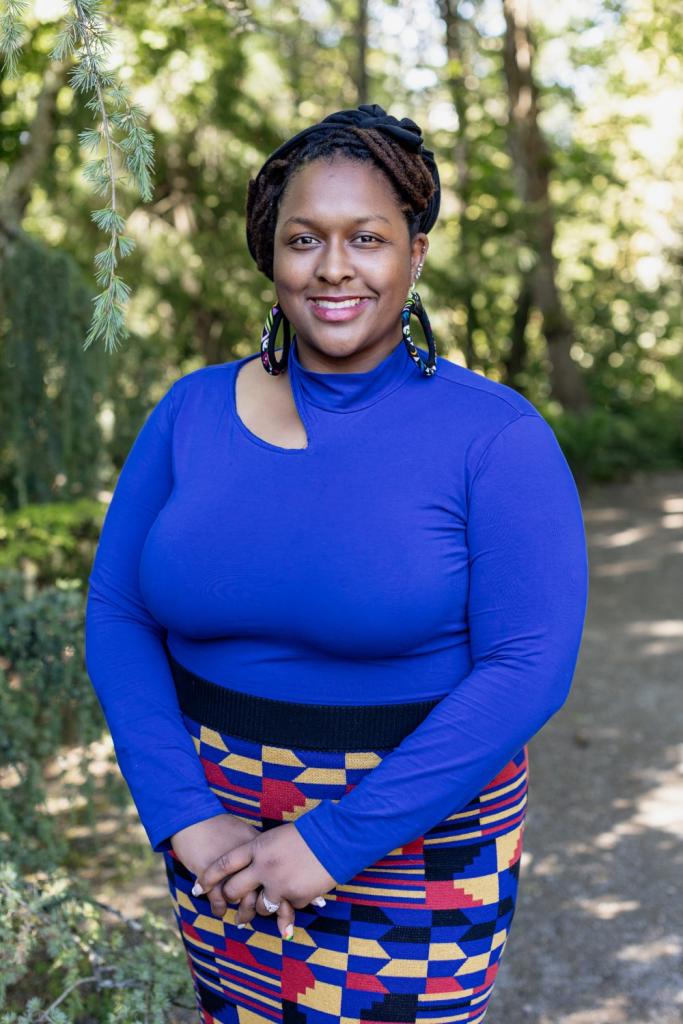
Dr. Britney Holmes, Ed.D., will be the first to tell you her path to education wasn't a straight line. She started out chasing medicine, pivoted to nursing and ended up in the College of Education only after a pregnancy put her on bed rest and gave her a month to think.
During that time, a pattern emerged: her life had always been about teaching children. She applied to the UW College of Education’s Master in Teaching program, drove back to Seattle from Idaho for the interview, and was accepted. "It had to be in 2013, because my daughter Tia was born in 2012," she recalled. "So I went back, and that's kind of what sparked it."
What followed was nearly a decade in Seattle Public Schools — as a classroom teacher, then assistant principal at Hazel Wolf K-8, then principal of Pathfinder K-8 in West Seattle — alongside a doctorate in Educational Leadership and Organizational Change from Seattle University.
A Seat at the table — and then some
From her very first student teaching placement, Dr. Holmes saw what unequal schooling looks like up close. Kids of color were being removed from classrooms for things like tapping a pencil or not having one at all. "They're being kicked out for just... stuff," she said. "And I knew that feeling. I could draw the parallel immediately."
Her master's research focused on keeping more students of color in the classroom. Her teaching practice was built around one core belief: that school should be a place where kids can simply be. As she moved into leadership, that belief only sharpened. "Equity isn't a slogan, it's a decision-making practice." Every role she stepped into, educator, assistant principal, then principal, was an opportunity to ask harder questions about who schools were actually designed to serve.
Equity as a decision-making practice
At Pathfinder K–8, Dr. Holmes found a school with a beloved tradition of multi-day camping trips — and a pattern she couldn’t ignore: students with intellectual and developmental disabilities were largely left out of that experience. She worked to change that, helping ensure more students could participate fully in a formative school tradition. The effort reflected her broader leadership approach: examining systems, challenging patterns of exclusion and building a school community where every student has the opportunity to belong and thrive.
The work was deeply meaningful and often challenging. "My role was to till the soil," she reflected. "I was not meant to be in that space to see the harvest. But I think being there removed some of the barriers that disempowered a ton of teachers to find their voice, and to use it."
And Still We Rise
Today, Dr. Holmes serves as Consulting Project Coordinator and Senior Liberation Consultant at And Still We Rise, founded in 2018 by her sister, Dr. Natasha Holmes. The organization offers mental health services and equity-centered consulting grounded in justice, healing and collective care, centering those most impacted by systemic harm while working to transform the institutions that shape their lives.
Through this work, she partners with school districts and organizations across the country to support leaders in building systems where belonging, accessibility and meaningful learning are possible for all.
After years of doing this work from inside school buildings, she found that joining And Still We Rise gave her both a wider reach and a chance to exhale. "Healthy places do exist," she said. "That's been really healing."
Her consulting work continues the mission she’s always pursued: coaching, training, and facilitating across school districts, non profits, government agencies, and beyond—supporting people in building skills, shifting mindsets, and removing the barriers that hold them back. “It’s the same work I tried to do as a building principal, just now at the state level,” she says.
What hope looks like
Despite everything she has witnessed and endured, Dr. Holmes holds onto a hope that is concrete and rooted in people she can name. The young teachers from Pathfinder who quietly spoke up and are now certified educators, carrying that work to New York and neighboring districts. The families of students with disabilities who, empowered by her support, shared, “I didn’t realize how bad it was until you got here.” These are the voices walking in their power, and the reason her hope endures.
For those just entering the field, her advice is direct: find a good therapist, don't take institutional dysfunction personally, and get clear on your “why.” "If your why is strong, you can get through all the things. But if you're waffling on that why, it won't be sustainable."
A living legacy
Dr. Holmes’ family — the Spence, Lynch, Stokes, West, and Holmes families — has called Seattle home for 109 years. Their presence has shaped the city, leaving imprints of resilience, community and care that continue to ripple through generations.
Her own path, from student teacher to principal to liberation consultant, is not a story of easy triumph. It is a story of persistence, of finding community in hard places, and of tilling soil she knew she might not see to harvest.
What she is most proud of, she said, is that the people she worked with felt truly seen, fully, in all of who they are. “When people are just able to be. Whatever that looks like. That’s what I’m most proud of.”
The roots run deep. And the work continues.
