Beyond the credits
Dr. Julia Duncheon on the hidden costs of accelerated college programs
Years ago in a Title I high school in Brooklyn, NY, Dr. Julia Duncheon, associate professor of Educational Policy, Organization and Leadership, watched administrators try to boost attendance and test scores with iPod raffles, a misguided strategy that ignored the real challenges students were facing. That disconnect between what schools measure and what actually matters still shapes her work today as an associate professor of educational policy at the UW College of Education.
Duncheon started as a high school history and special education teacher in New York City. Her path from teacher to researcher grew out of frustration with schools' narrow focus on test scores. That led her to graduate school, where she focused on college access for students of color and those from low-income neighborhoods. Now she leads a Spencer Foundation-funded study examining instructional quality and student experiences in dual enrollment programs, one of K-12 education's fastest-growing trends.
A rapid expansion and its challenges
Dual enrollment allows high school students to take college courses and earn college credit through a partnering institution of higher education, most often a community college. But the term covers a wide range of models. Courses may be taught by college faculty or by credentialed high school teachers and offered on high school campuses, college campuses, or online. Some students take a single course to explore college-level work, while others enroll in structured early college programs that enable them to complete up to two years of college coursework before graduating from high school.
The numbers are staggering. In 2004-2005, only 5% of high school students took a dual credit class. Twenty years later, that figure had more than tripled to 16%. By 2019, one-third of all high school students had taken at least one dual enrollment class by graduation. Over 90% of high schools now offer these programs — and growth shows no sign of slowing. Newly released federal data indicate that 2.8 million students nationwide participated in dual enrollment during the 2023–2024 academic year, a 12.7% increase from the previous year — roughly 300,000 additional students. Expansion has been widespread, with 26 states posting double-digit gains, including Washington, where participation grew by about 27%.
“These classes are just scaling really quickly,” Duncheon said. The appeal is clear: students can earn college credits while still in high school, potentially saving thousands of dollars and years of tuition, and gain some experience with college-level work. And students who take dual enrollment are more likely to enroll in college and complete a degree than students who don’t. By many accounts, dual enrollment seems like the answer to high college costs and low college completion rates, especially for low-income and first generation students. But Duncheon's research reveals a more complicated picture.
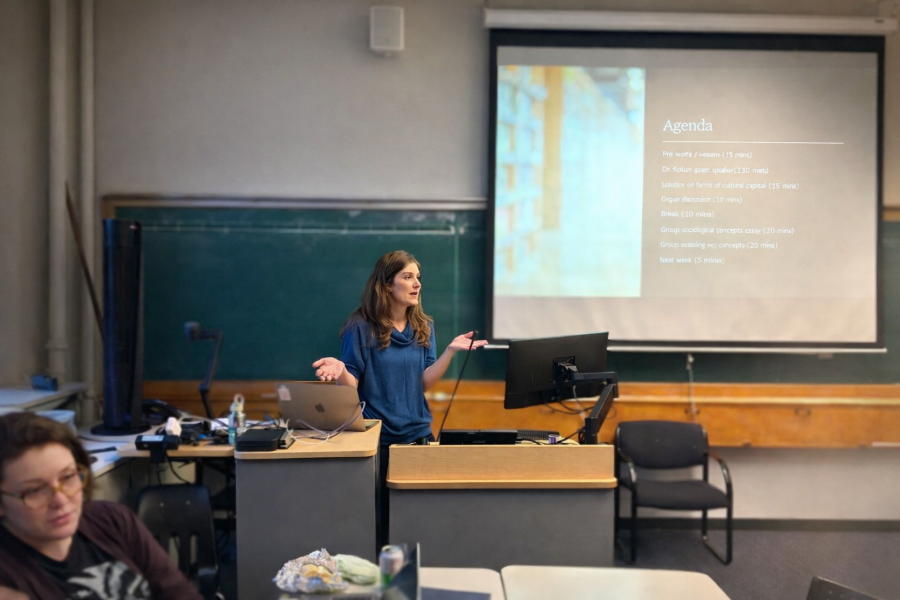
Her work examines a missing piece of the dual enrollment puzzle: what teaching and learning actually look like across different campuses and with different instructors. “What we've found is that course quality is really dependent on the teacher first and foremost ” she said. The setting matters less than the instructor, yet teachers receive remarkably little support. “Often, the way it works is the high school and the college form an agreement, and then the teacher gets handed a syllabus and told, ‘Go forth and teach college.’”
An ongoing challenge is ensuring rigor across dual enrollment classrooms. High school teachers are often teaching college for the first time, a departure from scripted K-12 curriculum. College faculty face their own challenges. “Faculty are not trained in pedagogy,” Duncheon noted. “They often have challenges that high school teachers don't have around either classroom management or just engaging adolescent learners.”
The solution requires institutional commitment to bridge the divide between K-12 and higher education. “You don't have to reinvent the wheel … you just have to bring educators together in a room and give them an opportunity to teach one another and learn from each other.” The most successful programs create structured planning time and professional development opportunities. “The institution is responsible for making it possible.”
The train has left the station
Perhaps the most striking findings come from students themselves. Duncheon’s team has talked to hundreds of students, during and after their participation in dual enrollment. While most students feel more academically prepared and appreciate the cost savings, there are some tradeoffs.
One study found that university students who graduated from early college, matriculating with junior-level credits, experienced a time crunch. Some students felt stuck in a major that no longer felt right. Others described the stress of finishing upper level coursework and looking for a job in just two years.
There were social costs, too. One history major explained how their peers who entered as freshmen took multiple classes with a beloved professor, building meaningful mentorship relationships. But this student could not do that because their favorite professor went on sabbatical during their brief time on campus.
Another student found a club they wanted to join but couldn't become an officer because they weren't a member long enough for people to know them and vote for them.
The connections that we make in college, whether it's with peers or professors or staff, those kind of relationships take time.
“The connections that we make in college, whether it's with peers or professors or staff, those kind of relationships take time,” Duncheon said. Early college graduates consistently reported not having enough time to engage in campus life, build networks, or prepare for life after graduation.
But most middle and high school students do not have the opportunity to consider these tradeoffs when they sign up for dual enrollment, especially if their parents did not go to college. When Duncheon's team asks high school students why they took dual enrollment, the answers are almost always the same.
“Nearly all of them want to save money on the cost of college and earn a degree faster, which is how these programs are marketed to them,” Duncheon said. “And these are clear benefits. But the college experience can offer students more than a credential, and we don’t do a good job of helping 14- and 15-year-olds understand all the costs and benefits of early acceleration.”
These findings raise important questions for equity. While affluent families encourage their children to explore college as an intellectual journey of self-discovery, first-generation and low-income students often receive a different message, one focused on efficiency and credentialing. The very students who could benefit most from college's transformative potential are instead taught to treat it like a transaction and complete as quickly as possible.
Duncheon has noticed quiet skepticism among program leaders beneath the public cheerleading. “I hear a lot of things like, well, the train has left the station,” she said. When she asks program leaders if they would encourage their own children to participate, “sometimes they say, ‘Oh no. No, I wouldn't.’”
The takeaway, for Duncheon, is the need for strategic and nuanced approaches to dual enrollment that maximize benefits for students and increase supports for instructors.
Reimagining education's purpose
As higher education faces pressure to justify itself in purely economic terms, Duncheon argues for a different conversation. “How do we shift the discourse so that we're talking about college access and completion in terms of democratic goals and not just economic outcomes?”
For Duncheon, the answer involves moving beyond the transactional benefits of dual enrollment — credits earned, money saved, time reduced — to ask what college learning fundamentally offers students: critical consciousness, self-discovery, the formation of citizens in a multi-racial democracy.
“It's hard to preserve a democracy when you have an education system fixated on credits and degrees,” she said.
As dual enrollment programs continue their rapid expansion, Duncheon's research offers a crucial reminder: efficiency isn't the same as effectiveness, and the fastest path isn't always the most meaningful one.
