Get to Know our EduDawgs: April Coloma Boyce
Our “Get to Know Our EduDawgs” series celebrates the incredible undergraduate and graduate students who make up the UW College of Education community. Through student interviews and storytelling, we’re highlighting the passions, experiences and perspectives that shape their journeys — in the classroom, in the community and beyond. 🌎✨
Each story is a glimpse into what drives our future educators, researchers and advocates to make a difference.
Editor's note: This interview was requested and coordinated by student associate Winston N. through the College of Education’s partnership with Cristo Rey Jesuit Seattle High School.
Meet April Coloma Boyce
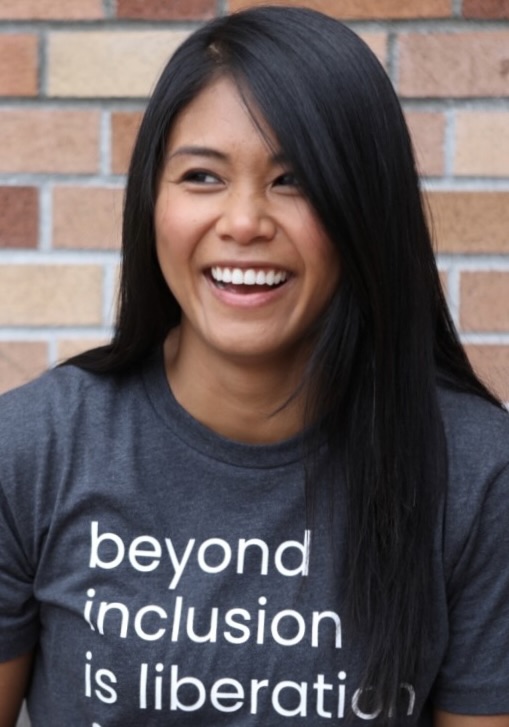
Seattle educator, researcher, mother, and Culturally Sustaining Education doctoral student April Coloma “AC” Boyce explores how children, families and communities practice care, connection and belonging through the Filipino value of kapwa, the idea that our well-being is deeply tied to one another. Her research challenges individualistic approaches to education and highlights the relational intelligence children demonstrate every day through collaboration and community care.
Inspired by this work, April created The Kapwa Project, a community-centered resource hub that supports families, educators, and neighbors in Northeast Seattle through mutual aid, shared learning, and local connection. Grounded in the question, “How do we take care of each other, right where we live?” the project brings research into practice and invites all of us to build stronger communities together.
Learn more about April by reading her Q&A below!
Can you explain your research — what's it about?
My research is about a Filipino value called kapwa. It roughly translates to "shared identity," or the idea that you and I are not separate — we are one. I'm studying how young children and their families already live out this value every day, especially families who have been pushed to the margins by race and disability. In my dissertation study, I'm facilitating a community playgroup where I spend time with young children in an outdoor space. I watch how they play, care for others, connect with nature, tell stories, and make meaning together. I document those moments to redefine the boundaries of learning — to show that children learn and express knowledge in many different ways, and that so much of it happens outside of school
What problem or question are you trying to solve, and why should people care?
Schools in the U.S. weren't built for every child. They were designed with a narrow idea of what a "good student" looks like — someone who sits quietly, learns one specific way, and finds success through independence. When a child doesn't fit that mold, schools have a long track record of blaming the student and finding a way to "fix" them through punishment or special education intervention.
My research argues that schooling is anti-kapwa. Think about a kindergartener who reaches over to comfort a friend who's upset during circle time, or a child who insists on working with a peer when the teacher wants silent independent work. Those behaviors are not problems — they are signs of deep relational intelligence. The real problem is a school system built around individualism, competition, compliance, and white middle-class norms that label collectivist behaviors as a deficit or disorder.
This matters because Black, Brown, and Indigenous children — many of whom are from collectivist cultures — are disproportionately labeled, disciplined, and pushed out of schools starting as early as preschool. That's not a coincidence. It's the result of a system designed to deem their cultural ways of being as flawed. My work tries to flip that script.
What's one big idea or takeaway you hope people remember from your work?
Interdependence is not a weakness — it is a form of intelligence. Kids already know how to genuinely take care of each other. They share, take turns, notice when someone's upset, and find ways to include their peers. That's not something they learned from a school lesson. It comes from lived experience being raised in families where those things actually matter.
We live in a culture that treats independence as the goal, but that idea has never been true for much of the world, and it has harmed communities whose survival has always depended on caring for one another. We don't need to teach children to look out for each other — that's innate. We just need to stop designing schools that make them forget how.
Who do you hope your research helps, and in what ways?
Most importantly, the children and families I work with directly. I want them to see their ways of being — their language, their care practices, their collectivist values — documented as legitimate and valuable, not as problems to be fixed. For early childhood educators, I hope my work offers a different lens. Instead of asking "why won't this child sit still and work alone," I want educators to ask "what is this child telling me about what they need to thrive, and what can we learn from their enactments of care at home and in their communities?"
For policymakers, I hope to challenge the idea that "inclusion" means making disabled and non-dominant children blend in. Real inclusion means building spaces that honor who they already are. And for my fellow Filipinos and other immigrant communities — especially those enduring the legacies of colonialism and navigating the fine line between survival and assimilation — I hope this research says: our ancestors' ways of knowing are not lost; they live on with our children.
What's something interesting or surprising you learned from sharing your work with other educators at the American Educational Research Association Annual Meeting (AERA)?
I actually presented on something different at AERA. I presented on a chapter I wrote with my colleague Malcom King, the first chapter in the book "Beyond Compliance in Early Childhood Education: Centering Disability, Freedom, and Belonging". Our advisor, Dr. Maggie Beneke was one of the co-editors. Our chapter is titled "Under the Circle Time Rug: The Eugenic Roots of Early Childhood Education" where we describe the histories and contexts of ableism in early childhood education. I was surprised and proud to hear from a faculty member at another university that they are assigning our chapter to teacher candidates in their teacher education programs, and students continue to reference it in their coursework!
